




Pieter Desmet
-
Current PhD projects
Jay Yoon Deger Ozkaramanli Mafalda Casais Katja Thoring Jenny Tsay Boudewijn BoonFinalized PhD projects
Steven Fokkinga Gael Laurans Erdem DemirRelated researchers
Anna Pohlmeyer Paul Hekkert Elif Ozcan Vieira Nynke Tromp Rick Schifferstein Valentijn Visch Marieke Sonneveld Annemiek van BoeijenRlated topics
Delft Institute of Positive Design Design and Emotion Society ID-Studiolab Emotion Studio
Product Emotion Measurement Instrument
Emotions elicited by product design are typically of low intensity and mixed character. To measure these typical product emotions, a non-verbal self-report tool was developed: Product Emotion Measurement Tool (PrEmo).
PrEmo is a non-verbal self-report instrument that measures seven positive and seven negative emotions. The unique strength of PrEmo is that it combines two qualities: it measures distinct emotions and it can be used cross-culturally because it does not ask respondents to verbalize their emotions. In addition, it can be used to measure mixed emotions. PrEmo data can be useful for evaluating the emotional impact of existing designs (e.g. for creating an emotional benchmark), or for creating insights in the relationship between product features and emotional impact that are valuable in an early design stage.
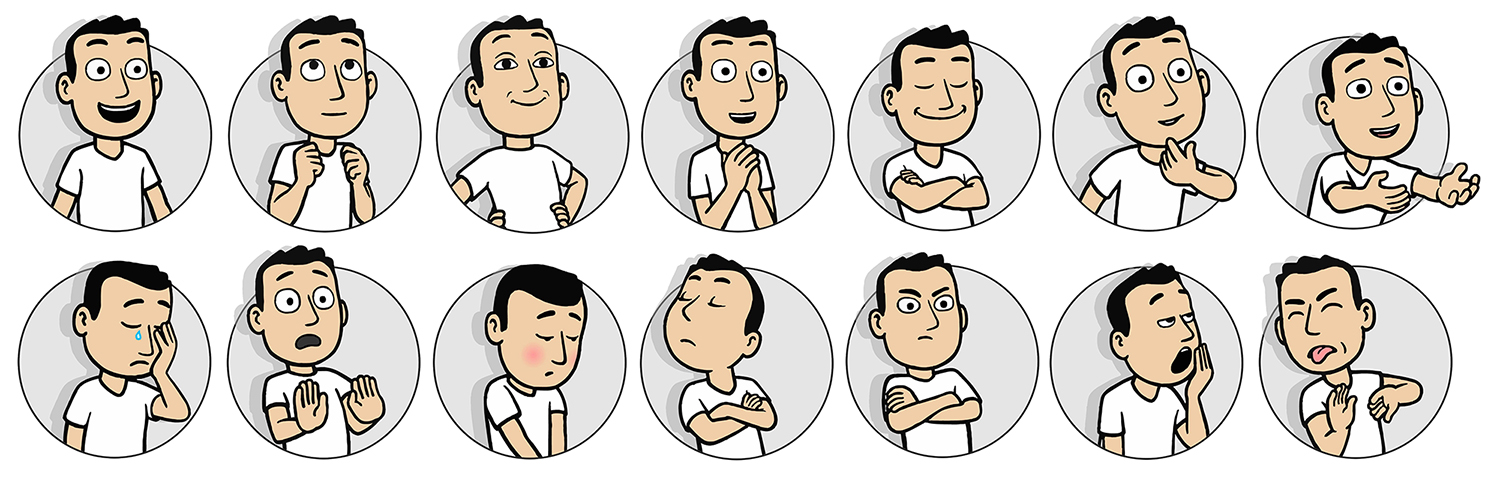
PrEmo measures distinct (pleasant and unpleasant) emotions in a non-verbal manner that is validated cross-culturally. PrEmo can be used both as a quantitative tool (e.g. to identify the concept with the most pleasant emotional impact) and as a qualitative tool (e.g. to use as a discussion tool in consumer interviews).
Publications
- Desmet P.M.A., Porcelijn, R., & van Dijk, M. (2007). Emotional design; application of a research based design approach. Journal of Knowledge, Technology & Policy, 20(3), 141-155.
- Desmet, P.M.A. (2003). Measuring emotion; development and application of an instrument to measure emotional responses to products. In: M.A. Blythe, A.F. Monk, K. Overbeeke, & P.C. Wright (Eds.), Funology: from Usability to Enjoyment (pp. 111-123). Dordrecht: Kluwer Academic Publishers.
- Desmet, P.M.A., & Dijkhuis, E. A. (2003). Wheelchairs can be fun: a case of emotion-driven design. Proceedings of the International Conference on Designing Pleasurable Products and Interfaces, June 23-26, 2003. Pittsburgh, Pennsylvania, USA. New York: ACM publishing.
- Desmet, P.M.A., Hekkert, P., Jacobs, J.J. (2000). When a car makes you smile: Development and application of an instrument to measure product emotions. In: S.J. Hoch, R.J. Meyer (Ed.), Advances in Consumer Research, 27, 111-117.
Availability
PrEmo is available for academic (non-commercial) usage free-of-charge, and for commercial use for rates as communicated on the SusaGroup website.
www.premotool.com
Free PrEmo license for non-commercial academic research:
academic licence request